
TL;DR
Amazon FBA fees jumped 8-10% for most sellers in 2026, Amazon killed its US prep services, and Seller Fulfilled Prime requirements are tightening in July. The best FBA alternatives depend on your situation: multi-node 3PLs like 4fillment work well for SFP sellers and fast-growing brands, Walmart Fulfillment Services offers lower fees for marketplace diversification, and self-fulfillment still makes sense for very early-stage operations. This guide covers 10 options with real pricing, honest tradeoffs, and a decision framework to help you pick.
Why Sellers Are Leaving FBA in 2026
Amazon announced that FBA fees would increase by an average of $0.08 per unit sold in 2026, or less than 0.5% of an average item’s selling price. That headline number is misleading. AMZ Prep, a fulfillment prep service, analyzed fee reports across hundreds of their clients and found that most sellers are actually paying 8-10% more, not 0.5%.
The reason for the gap? Amazon didn’t just raise fulfillment fees in January. It added a 3.5% fuel surcharge in April (averaging around $0.17 per unit), raised AWD West storage rates by 19%, bumped transportation costs by 22%, and restructured placement fees for mid-weight products. A sarcastic comment on the Seller Central forums captured the mood: “Thank you for not increasing our fees in 2025 but introducing inventory placement fees, low level inventory surcharge, long term inventory surcharges and increased return fees.”
For a detailed breakdown of these charges, see our FBA fees and surcharges guide.
Three other changes are pushing sellers to explore Amazon FBA alternatives in 2026:
Amazon ended US FBA prep and labeling. As of January 1, 2026, Amazon no longer offers prep and labeling services for FBA shipments in the US. Sellers are now fully responsible for making every product retail-ready before it reaches a fulfillment center. This creates new demand for external FBA prep services.
SFP speed requirements are tightening. Starting July 6, 2026, the minimum delivery speed thresholds for Seller Fulfilled Prime eligibility will rise across all size tiers. Standard-size items will need to display a one-day delivery date on 40% of Prime page views, up from 30%. For most single-warehouse operations, meeting these thresholds requires adding more warehouse locations.
The hybrid model is the 2026 play. Rising storage fees, punitive low-inventory surcharges, and the end of Amazon’s prep services have led many sellers toward a hybrid approach: keeping bestsellers in FBA while using 3PLs and alternative marketplaces for everything else. Relying solely on Amazon creates risk. If your account is suspended or policy changes occur, your entire business could take a major hit.
Quick Comparison Table
| Provider | Starting Cost | Min. Volume | US Warehouse Nodes | Best For | Key Limitation |
|---|---|---|---|---|---|
| 4fillment | from $2.25/order typical | Custom quote | 4 (CA, TX, GA, NJ) | SFP sellers, healthcare, fast-growing brands | Fewer nodes than largest incumbents |
| Walmart WFS | From $3.45/unit | None | Nationwide | Diversifying off Amazon | Smaller buyer pool than Prime |
| ShipBob | Quote-based (~$3.50+/order) | $275/mo | 50+ global | International DTC brands | Shipping markups, cost variance |
| ShipMonk | ~$3/pick + storage | $250/mo | 12+ global | Subscription/low-volume DTC | Hidden fees in reviews |
| Red Stag | Quote-based (premium) | ~$15-25M rev | 2 US | Heavy/bulky/high-value items | US-only, just 2 locations |
| eFulfillment Service | Low, no minimums | None | Limited US | Startups, low volume | Scalability ceiling |
| Flexport | Enterprise pricing | Varies | Global | Import-heavy brands | Overkill for pure DTC |
| FBM (self-managed) | $6.50-$9/order fully loaded | N/A | Your space | Hyper-custom, early-stage | Breaks at scale |
| SFP (structure) | $39.99/mo + fulfillment costs | 100+ orders/90 days | Depends on setup | Prime badge without FBA fees | Strict performance requirements |
| Self-Fulfillment | $6.50-$9/order | N/A | Your garage/warehouse | Under 50 orders/month | No Prime, capital-intensive |
The 3 Types of Amazon FBA Alternatives
Before comparing individual providers, it helps to understand the three structural categories. Every alternative to FBA falls into one of these buckets.
Fulfilled by Merchant (FBM): You handle all storage, pick, pack, and shipping yourself or through a 3PL, without using Amazon’s fulfillment network. FBM sellers avoid Amazon’s fulfillment and storage fees and can choose their own shipping carriers. The tradeoff is no Prime badge and a higher operational burden.
Seller Fulfilled Prime (SFP): You fulfill orders yourself (or through a 3PL) while earning the Prime badge. SFP fees are typically lower than FBA fees, but the performance requirements are demanding. You need a Professional selling account ($39.99/month), over 100 orders in 90 days, and must pass a 30-day trial period with guaranteed free two-day delivery. Failing to meet any requirement at any point results in exclusion from the program.
Third-party logistics (3PL): You outsource storage and fulfillment to an external provider who ships on your behalf. This is the most common FBA alternative for growing brands, and it can support FBM, SFP, or DTC fulfillment depending on the provider’s capabilities.
Most sellers end up combining two or more of these structures. That’s the hybrid model, and it’s where the real optimization happens.
10 Best Amazon FBA Alternatives
1. 4fillment
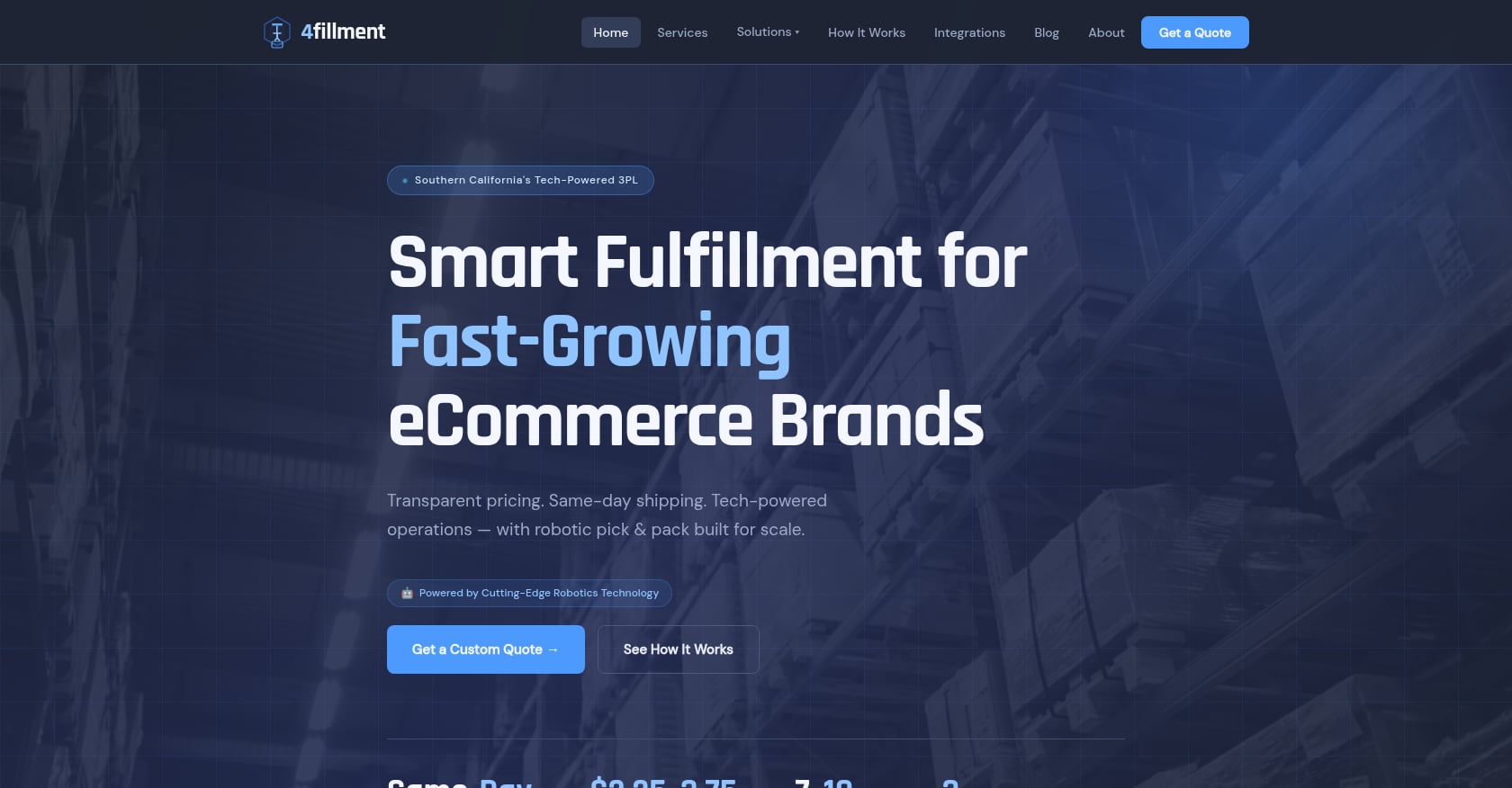
Best for: Fast-growing eCommerce brands needing SFP enablement, transparent pricing, and healthcare-logistics capabilities.
4fillment is a US-based, tech-powered 3PL that operates a multi-node network across California, Texas, Georgia, and New Jersey. This four-hub setup enables 1-2 day ground shipping to all US ZIP codes without relying on expensive air freight.
Pricing:
- a typical cost from $2.25 per order (excluding carrier shipping)
- Volume discounts available
- No long-term contracts
- Custom quotes with itemized pricing
Key features:
- Same-day shipping with robotic pick and pack for near-zero error rates
- Built specifically for SFP compliance: same-day handling, 99%+ on-time ship rate targets, ground-based 1-2 day coverage
- Direct integrations with Shopify, Amazon, Walmart, eBay, Etsy, plus API/ERP
- Slack alerts and real-time WMS visibility
- 7-10 day onboarding
- Healthcare logistics with FEFO, lot tracking, quarantine, and chain-of-custody documentation
Why it matters for SFP sellers: The July 2026 SFP tightening means sellers who built their Prime fulfillment around a single warehouse will struggle to hit the new speed thresholds. 4fillment’s four-hub network is designed exactly for this multi-node requirement. More SFP offers will need one-day or two-day national coverage, not just regional fast shipping.
Tradeoffs:
- Newer and smaller brand compared to incumbents with 40-60+ facilities
- Only the California street address is publicly listed; other hub locations are described generically
- No published case studies or third-party certifications on the website
For sellers evaluating SFP compliance or healthcare fulfillment, 4fillment’s SFP page breaks down exactly how their process maps to Amazon’s requirements.
2. Walmart Fulfillment Services (WFS)
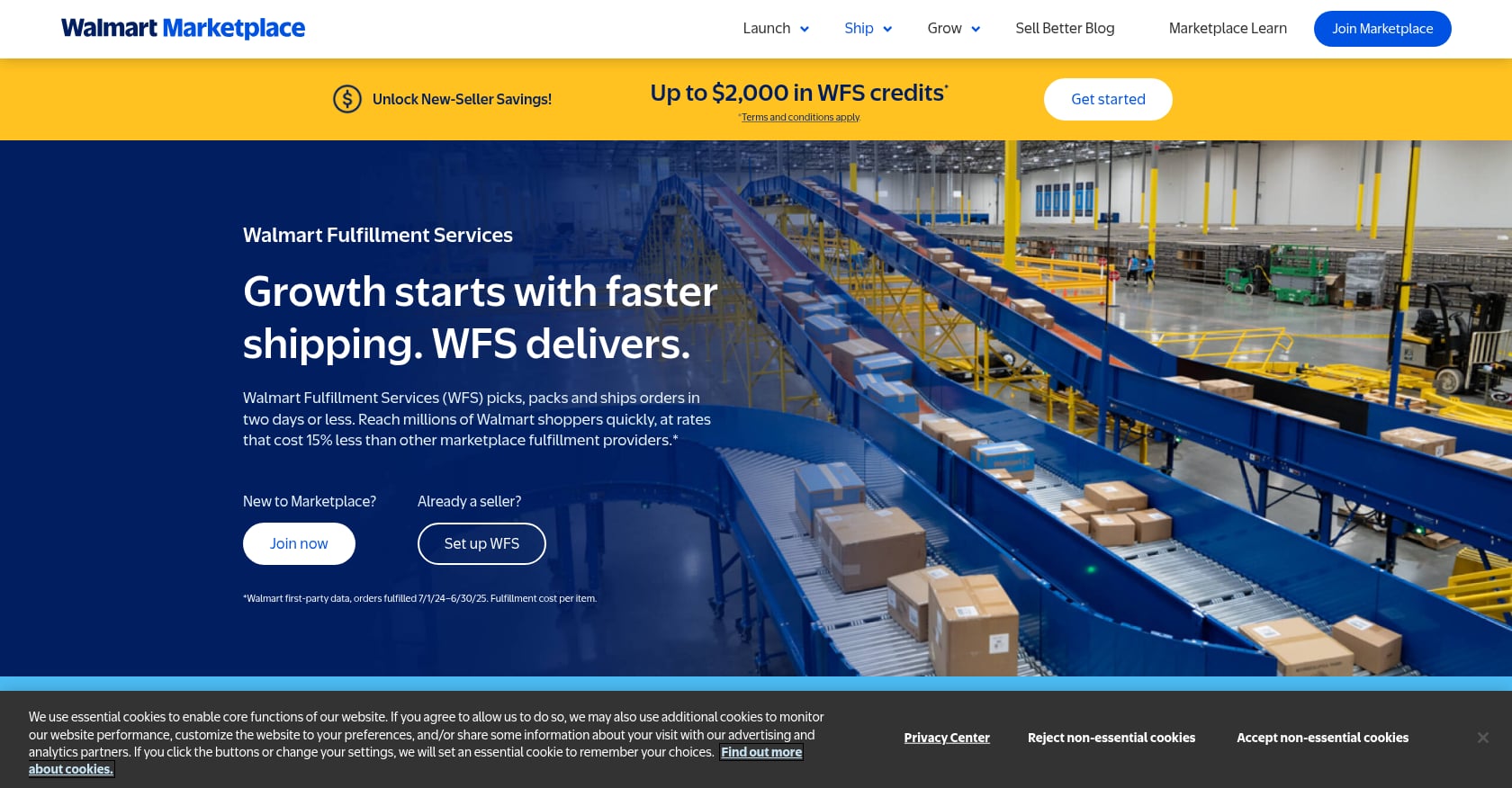
Best for: Sellers diversifying beyond Amazon who want a lower-fee marketplace fulfillment option.
WFS is Walmart’s answer to FBA, and it’s gotten aggressively competitive in 2026. Rates average 15% less than competitors, with no signup or monthly subscription fees. You pay a fulfillment fee (starting at $3.45 per unit) and a storage fee, with no minimums or maximums on inventory.
Pricing:
- Fulfillment fees starting at $3.45 per unit
- Storage: $0.75 per cubic foot (Jan-Sep), compared to Amazon’s $0.87 for the same period
- No signup fees, no monthly subscription
Key features:
- Sellers using WFS see 50% GMV growth on average for items with “Fulfilled by Walmart” and “2-day shipping” tags
- Walmart’s 2026 New-Seller Savings program offers up to $75,000 in total value for new marketplace sellers
- Multichannel fulfillment now available (not just Walmart.com)
Tradeoffs:
- Walmart’s buyer audience is still smaller than Amazon Prime
- The marketplace is less mature for third-party sellers
- Product category restrictions are tighter than Amazon’s
For sellers already exploring Walmart as a channel, a 3PL with Walmart fulfillment integration can handle both WFS prep and direct Walmart orders.
3. ShipBob
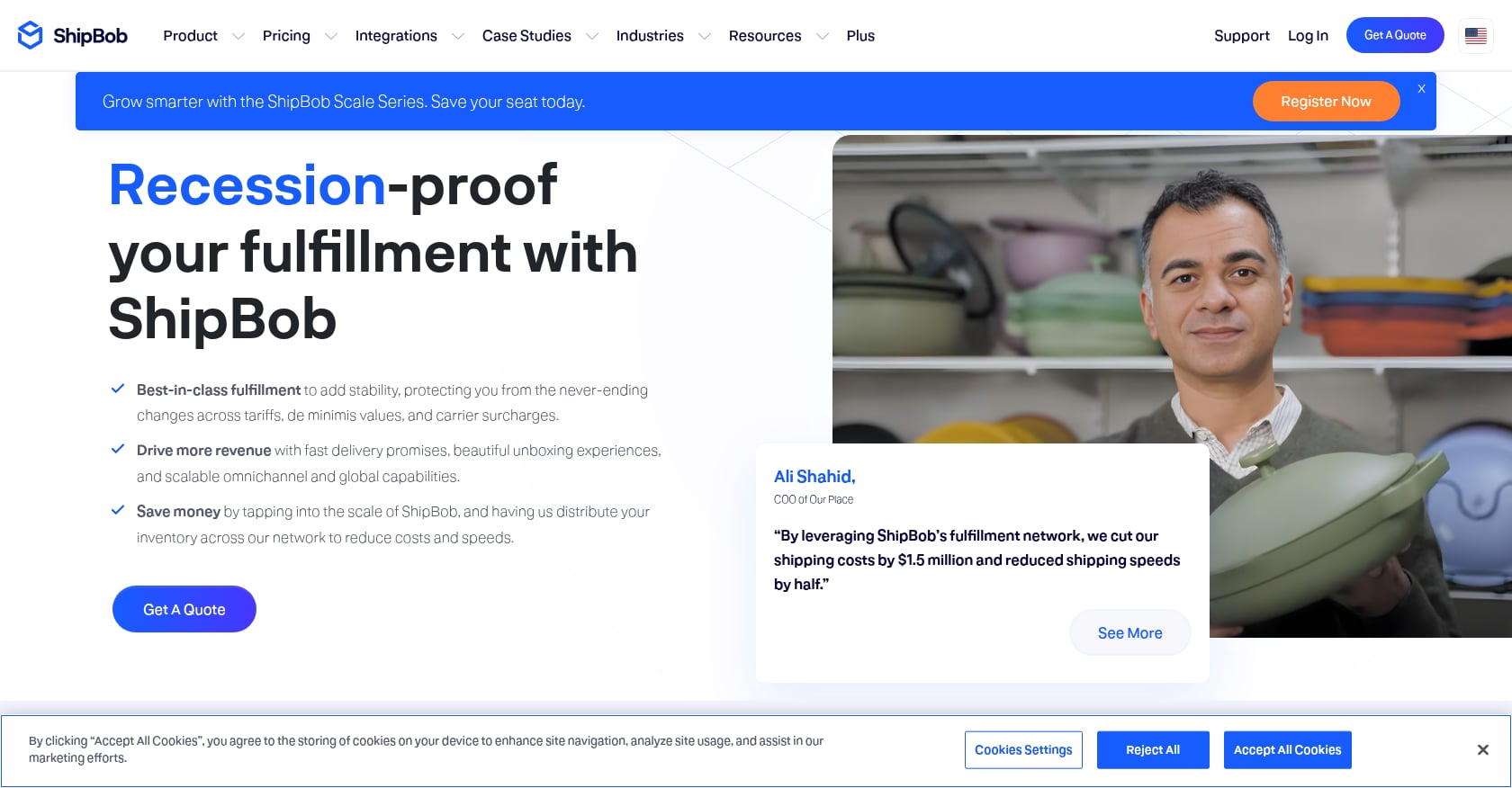
Best for: Growing DTC brands needing international reach and two-day US shipping.
Founded in 2014, ShipBob serves over 5,000 eCommerce businesses with a network of 50+ fulfillment centers, offering two-day shipping to 99% of the US. It’s one of the most recognized names in the 3PL space, particularly among Shopify brands.
Pricing:
- Quote-based only (no published rates)
- Per a competing 3PL’s analysis: fees include a $275/month minimum, $975 setup fee, $0.30/pick, storage tiers, and postage markups of 15-30%
- Full implementation package starts at $975 with a dedicated specialist for 30 days
Key features:
- 50+ global fulfillment centers
- Strong international shipping capabilities
- Integrations with major eCommerce platforms
- Two-day express shipping program
Tradeoffs:
- Significant quote-to-actual cost discrepancies have been documented, with some merchants reporting costs 143-243% higher than initial estimates
- ShipBob removed published pricing, making it harder to compare upfront
- Credit card surcharges on payments
- Postage markups of 15-30%
User perspective: On Capterra, one reviewer noted “the value for money is great as compared to others I have used,” but the volume of complaints about billing surprises is hard to ignore. Practitioners on Reddit frequently cite ShipBob’s shipping markups as a hidden margin killer that only becomes visible after onboarding.
4. ShipMonk
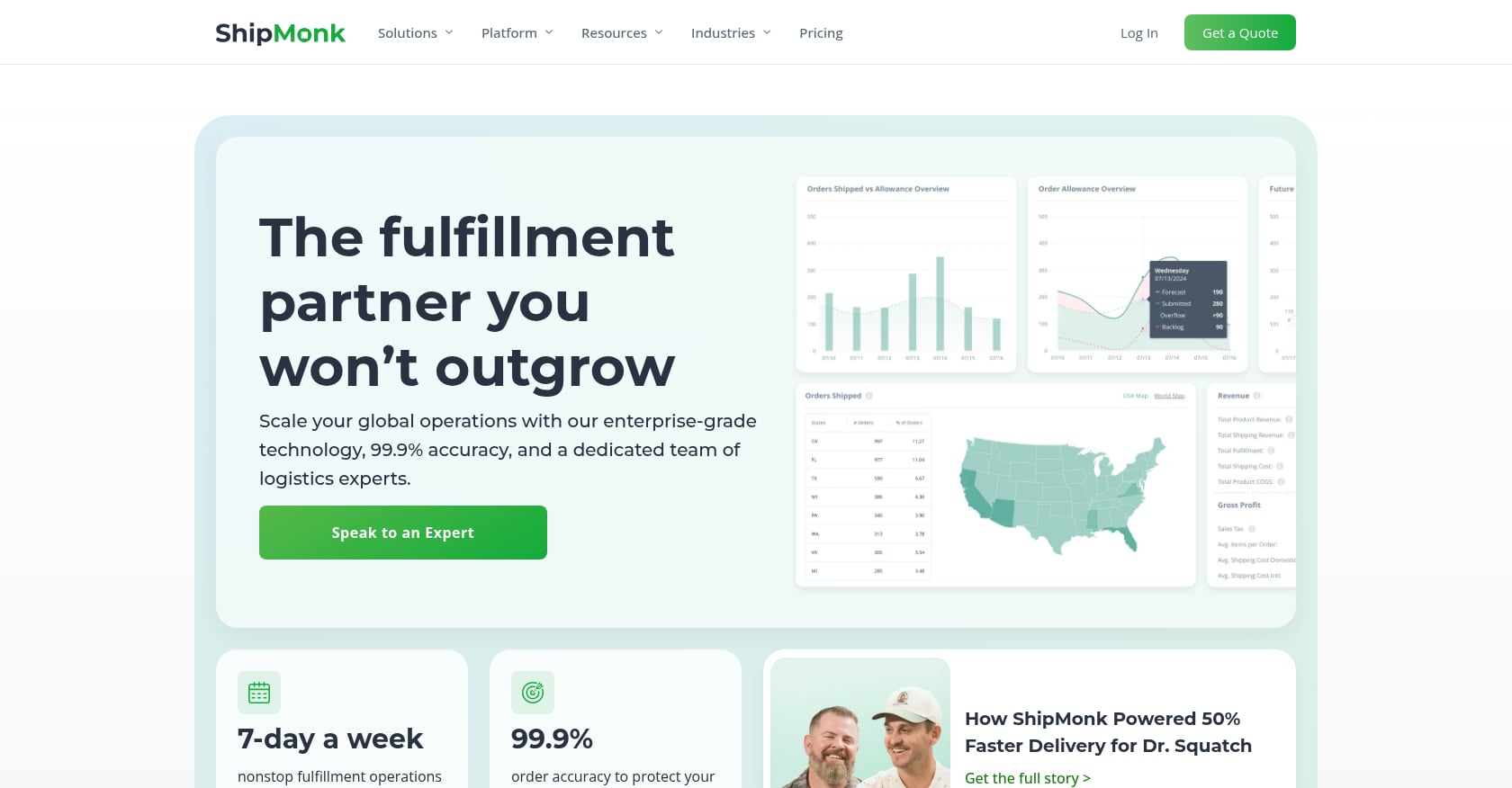
Best for: Subscription box brands and DTC sellers under 400 orders/month who want an easy-to-use interface.
ShipMonk, founded in 2014 and headquartered in Fort Lauderdale, handles warehousing, pick-and-pack fulfillment, inventory management, and shipping for eCommerce businesses. Its distributed warehouse model allows brands to split inventory across multiple locations for two-day ground shipping to roughly 95% of the US population.
Pricing:
- Order pick fee: $3 per order
- Return processing: $2 per return
- $250/month minimum (no setup fee)
- Slightly lower entry point than ShipBob, making it the better starting point under 400 orders/month
Key features:
- 12+ global warehouse locations
- User-friendly dashboard and interface
- Subscription box kitting capabilities
- Multi-location inventory splitting
Tradeoffs:
- Most Capterra reviewers report pricing involves hidden fees, frequent billing errors, and unexpected charges, making the overall cost much higher than initially anticipated
- A 6+ month exit process, according to multiple user reports
- Billing disputes are a recurring theme in customer reviews
The exit trap is worth emphasizing. Practitioners on forums describe ShipMonk’s offboarding process as drawn out and frustrating, with some reporting it took over six months to fully transition away. If you’re considering ShipMonk, factor in the switching cost before signing up. For a broader perspective on choosing a fulfillment partner, exit terms should be near the top of your evaluation checklist.
5. Red Stag Fulfillment
Best for: Heavy, bulky, and high-value goods where accuracy matters most.
Red Stag is a US-based 3PL founded in 2013, operating 1.15 million square feet across Sweetwater, Tennessee and Salt Lake City, Utah. They publish hard accuracy numbers that few competitors match: 99.99% inventory accuracy, 99.99% pick accuracy, and 99.96% shipping accuracy. They also offer a zero-shrinkage guarantee.
Pricing:
- Custom quotes only (no published rates)
- Generally considered premium pricing
- Target client profile: eCommerce companies with $15-25M in annual revenue
Key features:
- Zero-shrinkage guarantee
- Specialization in oversized, heavy, and high-value items
- Industry-leading published accuracy metrics
- Same-day fulfillment for orders placed by cutoff
Tradeoffs:
- Only 2 US warehouse locations, which limits zone optimization for nationwide delivery
- US-only operations
- Charges a Small Package Fee for items under 16 ounces, which penalizes sellers of small, lightweight items
- Revenue threshold makes it impractical for small and mid-sized sellers
6. eFulfillment Service
Best for: Startups and low-volume sellers needing no-minimum flexibility.
Founded in 2001, eFulfillment Service (EFS) has built a reputation for simplicity, transparency, and customer service. The standout feature is the no minimum order requirement. Their pricing model has no setup fees, no long-term contracts, and no surprise surcharges.
Pricing:
- Low per-order costs (quote-based but transparent)
- No minimums on orders or inventory
- No setup fees or long-term contracts
Key features:
- True zero-minimum model
- Straightforward pricing with no hidden fees
- Over two decades of operating history
- Simple onboarding process
Tradeoffs:
- Fewer warehouse locations than larger competitors
- Less scalable for high-volume operations (hundreds of orders per day)
- Limited technology integrations compared to newer platforms
- Not suited for brands that need multi-node distribution
EFS is a solid starting point for sellers doing 10-100 orders per month who aren’t ready for the complexity (or minimums) of a larger 3PL. Once you outgrow it, transitioning to a multi-node provider becomes the next step.
7. Flexport
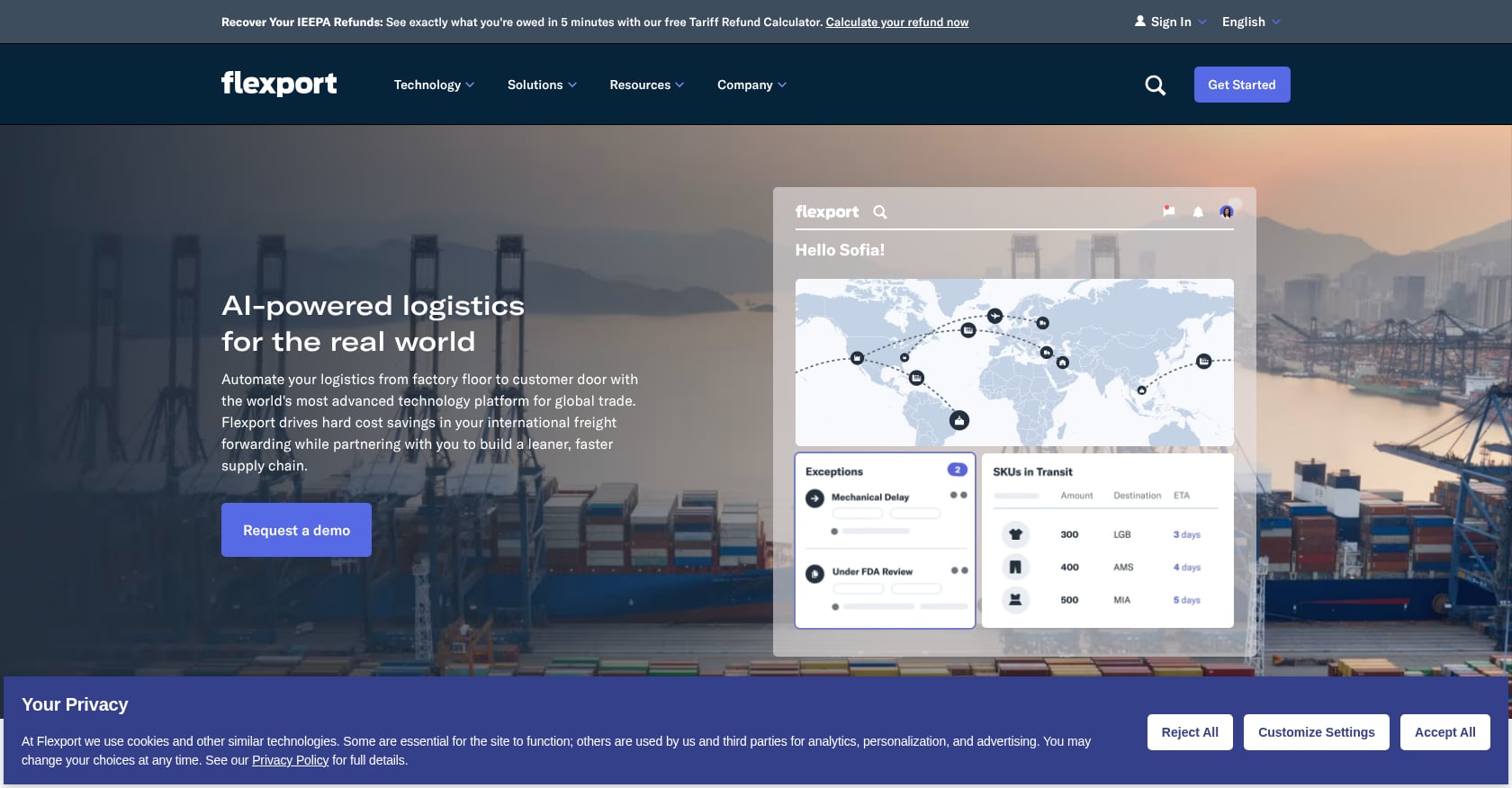
Best for: Import-heavy brands needing end-to-end logistics from freight forwarding to last-mile delivery.
Flexport is a technology-forward logistics solution that simplifies global trade with freight forwarding, customs clearance, supply chain management, and domestic fulfillment. It’s the only option on this list that covers the full journey from factory floor to customer doorstep.
Pricing:
- Enterprise-oriented, custom quotes
- Pricing reflects the breadth of services (freight, customs, warehousing, last-mile)
- Generally more expensive than pure domestic 3PLs
Key features:
- Integrated freight forwarding and customs clearance
- Global supply chain visibility platform
- Domestic warehousing and fulfillment
- Strong for complex, multi-country supply chains
Tradeoffs:
- Overkill for pure DTC brands without import complexity
- Enterprise pricing that’s prohibitive for smaller sellers
- The platform is built for supply chain management, not optimized as a pure pick-and-pack operation
- Less competitive on domestic-only fulfillment speed and cost
8. Fulfilled by Merchant (FBM)
Best for: Margin-sensitive SKUs, oversized products, and sellers wanting full control over branding and customer experience.
FBM isn’t a provider. It’s a structural choice. You list on Amazon but handle (or outsource) all fulfillment yourself. FBM sellers avoid Amazon’s fulfillment and storage fees, choose their own shipping carriers, and can customize packaging to enhance the shopping experience.
Cost structure:
- No Amazon fulfillment fees
- You pay for your own storage, labor, packaging, and shipping
- Costs vary widely depending on whether you self-fulfill or use a 3PL
Key advantages:
- Full control over branding and unboxing experience
- Direct customer relationships
- Multi-channel fulfillment from one inventory pool
- Essential for oversized products where FBA fees are punitive
Tradeoffs:
- No Prime badge (unless you qualify for SFP)
- Higher operational burden if self-fulfilling
- Need to maintain competitive shipping speeds to win the Buy Box
- FBM remains essential for margin-sensitive SKUs, oversized products, and customizable packaging, but it’s not a complete FBA replacement for most sellers
Understanding the differences between fulfillment models helps clarify which combination makes sense for your catalog.
9. Seller Fulfilled Prime (SFP)

Best for: Sellers who want the Prime badge while controlling fulfillment costs and branding.
SFP is the middle ground between FBA and FBM. You keep the coveted Prime badge, but you (or your 3PL) handle fulfillment. SFP fees are typically lower than FBA’s, though the performance requirements are strict and getting stricter.
Requirements:
- Professional selling account ($39.99/month)
- Over 100 orders in 90 days
- On-Time Delivery Rate of 93.5% or higher
- Valid Tracking Rate of 99% or higher
- Order Defect Rate under 1%
- Pre-Fulfillment Cancel Rate under 0.5%
- Late Shipment Rate under 4%
- Pass a 30-day trial period with guaranteed free two-day delivery
What’s changing in July 2026:
Standard-size items will need to display a one-day delivery date on 40% of Prime page views, up from 30%. This effectively forces most sellers into multi-warehouse setups.
Tradeoffs:
- Failing any metric at any point results in SFP exclusion
- The July 2026 changes make single-warehouse SFP nearly impossible for national coverage
- Requires significant operational discipline or a capable 3PL partner
- More complex to manage than simply shipping to Amazon’s warehouses
For a detailed comparison of the two approaches, our guide on Seller Fulfilled Prime vs. FBA covers the cost and operational differences.
10. Self-Fulfillment (In-House)
Best for: Very early-stage sellers under 50 orders/month, or brands with hyper-specific packaging and customization needs.
Before you outsource anything, self-fulfillment is where most sellers start. It gives you complete control over every aspect of the customer experience.
Cost breakdown:
- Pack labor: $1.20-$1.80 per order
- Packaging: about $0.50 per order for a poly mailer
- Allocated storage rent: $0.30-$0.60 per order
- Postage: $4.50-$6.00 for a light US parcel
- Total fully loaded cost: roughly $6.50-$9.00 per order
Key advantages:
- Zero dependencies on third parties
- Complete branding control
- Immediate feedback loop on product quality and packaging
- No minimums, no contracts, no onboarding process
Tradeoffs:
- Breaks at scale (once you’re past 50-100 orders/day, the economics and time demands become untenable)
- No Prime badge without SFP qualification
- Capital-intensive if you need dedicated warehouse space
- Your time has an opportunity cost that doesn’t show up in the per-order math
The math on self-fulfillment usually breaks down between 50 and 200 orders per month. At that point, the signs that you’re ready for a 3PL start becoming obvious: missed shipments, storage overflow, and weekends spent packing boxes instead of growing the business.
How to Choose the Right Amazon FBA Alternative
Instead of picking the “best” option in a vacuum, use this decision framework based on your actual situation:
Still selling primarily on Amazon? Consider SFP paired with a multi-node 3PL to keep the Prime badge while cutting fulfillment costs. The July 2026 SFP changes make this more urgent, not less. A provider with hubs in multiple US regions (like 4fillment’s CA, TX, GA, NJ network) gives you the geographic coverage the new rules demand.
Diversifying across marketplaces? WFS for Walmart, plus a 3PL that integrates with multiple channels. Running separate fulfillment for each marketplace is a recipe for inventory headaches.
DTC-first brand? Prioritize a 3PL with strong Shopify integration, branded packaging options, and fast shipping. ShipBob’s international network works if you sell globally. For US-focused brands, a domestic multi-node 3PL is usually more cost-effective.
Selling healthcare, diagnostics, or regulated products? You need FEFO inventory management, lot tracking, quarantine capabilities, and chain-of-custody documentation. Most generalist 3PLs don’t offer this. 4fillment’s healthcare logistics capabilities are specifically built for this use case.
Shipping heavy or bulky items? Red Stag’s specialization and zero-shrinkage guarantee make it the clear choice, assuming you meet their revenue threshold.
Just getting started? Self-fulfillment until you hit 50+ orders/month, then eFulfillment Service for the no-minimum flexibility, then graduate to a multi-node 3PL when volume justifies it.
The Pricing Transparency Test
One pattern worth highlighting: multiple user reviews across ShipBob and ShipMonk cite hidden fees as a top complaint. When some merchants report costs 143-243% higher than initial estimates, pricing transparency stops being a “nice to have” and becomes a critical evaluation criterion.
Before signing with any 3PL, ask for an itemized quote based on your actual SKU data, not a generic rate card. Ask what’s not included. Ask about fuel surcharges, packaging fees, receiving fees, and return processing. The providers that give you clear, upfront numbers are the ones less likely to surprise you on invoice day.
Ready to compare costs for your specific catalog? Get an itemized quote from 4fillment based on your actual order volume and SKU mix.
Frequently Asked Questions
What is the cheapest alternative to Amazon FBA?
For very low volumes (under 50 orders/month), self-fulfillment is cheapest at roughly $6.50-$9.00 per order fully loaded. Among 3PL providers, eFulfillment Service has the lowest barrier to entry with no minimums and no setup fees. For higher volumes, 4fillment’s a typical cost from $2.25 per order (excluding carrier shipping) is competitive, and Walmart Fulfillment Services starts at $3.45 per unit with storage rates lower than Amazon’s.
Can I keep the Prime badge without using FBA?
Yes, through Amazon’s Seller Fulfilled Prime (SFP) program. You need a Professional selling account, over 100 orders in 90 days, and must meet strict performance metrics including a 93.5%+ on-time delivery rate and 99%+ valid tracking rate. Starting July 2026, the speed thresholds are increasing, making multi-warehouse fulfillment setups essential for most sellers.
How much does a 3PL cost per order?
It varies significantly. Self-fulfillment runs $6.50-$9.00 per order. Budget 3PLs like eFulfillment Service come in lower but with limited services. Mid-tier providers like 4fillment typically charge from $2.25 per order (excluding carrier shipping). ShipBob and ShipMonk start around $3.00-$3.50+ per order, but user reviews frequently report higher actual costs due to markups and ancillary fees. Always request an itemized quote based on your specific SKU dimensions and order volume.
What happened to Amazon’s FBA prep services?
As of January 1, 2026, Amazon no longer offers prep and labeling services for FBA shipments in the US. Sellers are now fully responsible for ensuring every product is retail-ready before it reaches Amazon’s fulfillment centers. This has created significant demand for external FBA prep providers.
Is Walmart Fulfillment Services worth it in 2026?
For sellers looking to diversify beyond Amazon, WFS is increasingly compelling. Rates average 15% less than competitors, storage fees are lower ($0.75 vs. $0.87 per cubic foot for standard months), and Walmart’s 2026 New-Seller Savings program offers up to $75,000 in value for new sellers. The main limitation is that Walmart’s buyer audience is still smaller than Amazon Prime’s, so it works best as a diversification play rather than a complete replacement.
What is the hybrid fulfillment model?
The hybrid model means keeping your bestsellers in FBA for maximum Prime visibility while using a 3PL or alternative marketplace fulfillment for everything else, including slow-moving inventory, oversized items, DTC orders, and non-Amazon marketplace sales. This approach reduces FBA storage fees, lowers the risk of account dependency, and gives you more control over branding and customer experience for a portion of your orders.
How do I know when to switch from self-fulfillment to a 3PL?
The breakpoint typically falls between 50 and 200 orders per month. Warning signs include missed shipping deadlines, storage space overflowing into living areas, weekends consumed by packing, and increasing error rates. When the time you spend fulfilling orders has a higher opportunity cost than what a 3PL charges, it’s time to outsource.
What should I look for in a 3PL for SFP compliance?
The non-negotiables are same-day order handling, multiple warehouse locations for geographic coverage, a valid tracking rate above 99%, and a proven on-time delivery rate above 93.5%. With the July 2026 SFP speed threshold increases, single-warehouse 3PLs will struggle to maintain SFP eligibility for national sellers. Look for providers with nodes in at least three US regions and a track record of meeting Amazon’s performance metrics.
Still weighing your options? Schedule a discovery call with 4fillment to see how their multi-node network, transparent pricing, and SFP specialization stack up against your current fulfillment costs.