
TL;DR
The best order fulfillment companies are not the ones with the most warehouses. They are the ones that match your order volume, SKU profile, delivery promise, and budget. For fast-growing U.S. ecommerce brands that need same-day handling, transparent pricing, and specialty workflows like SFP or healthcare logistics, 4fillment is the strongest starting point. For large global networks, ShipBob leads. For heavy and bulky products, Red Stag is the specialist. Read the full comparison below to find the right fit.
Fulfillment Is a Growth Lever, Not a Back-Office Task
Shoppers have zero patience for slow shipping. A State of Shipping report found that 62% of consumers expect free-shipping orders to arrive in under three business days, and 56% of abandoned carts were tied to delivery concerns source. Meanwhile, returns keep climbing. The National Retail Federation estimated $849.9 billion in U.S. merchandise returns in 2025, representing 15.8% of annual retail sales source.
The U.S. third-party logistics market hit $323.4 billion in 2025 source. That number reflects a simple truth: brands that try to pick, pack, and ship every order themselves eventually hit a wall. The question is not whether to outsource fulfillment. It is which order fulfillment company deserves your inventory, your customers’ first impressions, and your trust.
This guide compares nine ecommerce fulfillment companies by cost, speed, technology, user sentiment, and specialty workflows. Every recommendation includes honest tradeoffs, real user feedback from review platforms and forums, and pricing details that go beyond “contact us for a quote.”
At-a-Glance Comparison Table
| Company | Best For | Pricing / Minimums | Network | Key Differentiator | Main Tradeoff |
|---|---|---|---|---|---|
| 4fillment | Fast-growing DTC, SFP, FBA prep, healthcare | from $2.25/order (excl. shipping) | CA, TX, GA, NJ | Robotic pick-and-pack, SFP workflows, healthcare logistics | Limited public social proof; buyers should verify facilities |
| ShipBob | Scaling DTC needing broad network | Impl. from $975; $275/mo minimum | 60+ U.S., 10 intl. | Large network, strong dashboard | Cost complexity; peak-season lag reported |
| Red Stag | Heavy, bulky, high-value products | Custom; free onboarding, 30-day guarantee | 2 U.S. warehouses | 100% accuracy guarantee, heavy-item specialization | Not for apparel or high-SKU catalogs |
| ShipMonk | Subscription boxes, kitting, crowdfunding | Structured minimums by volume | 8 U.S. warehouses | Kitting and subscription workflows | Mixed reviews on hidden fees and delays |
| Shipfusion | Brands wanting strong account management | Custom quote | Multi-warehouse | Dedicated account managers, communication cadence | Less pricing transparency |
| Amazon MCF/FBA | Amazon-native sellers | Per-unit fees; 3.5% surcharge from May 2026 | 150+ U.S. centers | Massive network, Prime delivery | Limited control, complex fee changes |
| ShipHero | WMS-driven hybrid fulfillment | Custom all-in; WMS from $1,995/mo | 7 U.S., 2 Canadian | WMS-first, hybrid model | High minimums for small brands |
| eFulfillment Service | Startups, no minimums | No setup fees, no minimums | 1 Michigan location | Startup-friendly terms | Single location, sparse reviews |
| Flexport | Freight + fulfillment + customs | Usage-based; $5,000/mo minimum from Jan 2026 | Integrated global | End-to-end supply chain platform | Expensive for simple DTC fulfillment |
How We Ranked These Order Fulfillment Companies
A useful ranking needs a transparent methodology. Here is what we weighted:
- Use-case fit (25%): Does the provider specialize in the reader’s order profile, whether DTC, Shopify, Amazon, subscription, B2B, healthcare, or startup?
- Cost transparency (20%): Does the company disclose enough about per-order fees, storage, receiving, minimums, returns, surcharges, and onboarding?
- Speed and coverage (20%): Can the provider support same-day handling, 2-day delivery, and multi-node routing without relying heavily on air?
- Technology and visibility (15%): WMS quality, dashboard, integrations, inventory visibility, order routing, and exception handling.
- Support and real user sentiment (10%): Review themes from G2, Capterra, Trustpilot, Reddit, and practitioner forums. Recurring patterns matter more than isolated reviews.
- Specialty workflows (10%): Kitting, returns inspection, B2B/EDI, FBA/SFP prep, lot/expiry tracking, regulated goods, and subscription fulfillment.
Pricing varies by order volume, SKU count, product dimensions, packaging, carrier mix, return rate, and channel mix. The figures cited below come from published sources and supplied company information, not from custom quotes we received.
The 9 Best Order Fulfillment Companies
1. 4fillment
Best for: Fast-growing U.S. ecommerce brands that need same-day DTC fulfillment, Seller Fulfilled Prime support, FBA prep, returns processing, and healthcare logistics.
4fillment is a U.S.-based, tech-powered 3PL built around robotic pick-and-pack operations across hubs in California, Texas, Georgia, and New Jersey. The company claims 1 to 2 day ground coverage nationwide from those four nodes, which matters because ground shipping is far cheaper than air. For brands scaling past the point where in-house fulfillment makes sense, the combination of same-day shipping cutoffs, transparent per-order pricing, and specialty workflows makes this the strongest starting point.
Pricing:
- Custom quote required
- typical cost cited: from $2.25 per order, excluding carrier shipping
- Volume discounts available
- No published plan tiers or long-term contracts
- Itemized proposal within approximately 48 hours of discovery call
- Onboarding in as few as 7 to 10 days
Key features:
- Robotic pick-and-pack with near-zero error rate claims
- Same-day shipping cutoff
- Multi-node U.S. routing with automatic hub selection
- Shopify, Amazon, Walmart, eBay, Etsy integrations plus API and ERP-ready workflows
- Amazon FBA prep and Seller Fulfilled Prime enablement
- B2B/wholesale fulfillment with retail-compliant handling
- Returns processing with inspection, restock, and disposition workflows
- Healthcare logistics: lot/expiry tracking, FEFO, quarantine, chain-of-custody, specimen return logistics, temperature-aware handling
- Real-time WMS visibility and Slack alerts
Tradeoffs:
- Limited public social proof. No published case studies, customer logos, or third-party review profiles were found in our research. Buyers should request references and compliance documentation during discovery.
- Only the California street address is publicly listed. The Texas, Georgia, and New Jersey hubs are described generically.
- No public SOC 2, ISO, or FDA facility certifications are listed. Healthcare and regulated-product brands should verify credentials directly.
- Fewer total nodes than large incumbents with 40 to 60+ facilities.
When 4fillment is not the right fit:
If you require a provider with dozens of published warehouse addresses, public enterprise case studies, or third-party certifications visible before a discovery call, 4fillment may not satisfy your procurement process. It is strongest for brands that value fast onboarding, transparent pricing benchmarks, same-day operations, SFP workflows, and specialty fulfillment, and are willing to validate references during the sales process.
To compare your current fulfillment cost against 4fillment’s pricing model, request a discovery call at 4fillment.com.
2. ShipBob
Best for: Scaling DTC brands that need a broad fulfillment network and mature dashboard.
ShipBob is one of the most recognized names among ecommerce order fulfillment companies. Its strength is network size and standardized technology. For brands with distributed demand across the U.S. and international markets, the sheer number of facilities makes zone-based shipping optimization straightforward.
Pricing:
- Implementation starting at $975
- Storage: $40/month per pallet, $10/month per shelf, $5/month per bin
- Receiving: $35 for the first two hours, $45/hour after
- $275 monthly fulfillment minimum
- 3% credit card processing fee
Key features:
- 60+ U.S. and 10 non-U.S. fulfillment locations
- Two-day shipping options
- DTC, subscription, B2B, dropship, and EDI support
- Dashboard for inventory, orders, tracking, and analytics
- Integrations with Shopify, Amazon, WooCommerce, BigCommerce, TikTok Shop
- FreightBob and WMS offerings
- Custom packaging and kitting
Tradeoffs:
- Cost can be difficult to forecast once you model storage, receiving, card fees, kitting, and minimums.
- G2 users praise the interface and integrations but note slow performance during peak seasons, glitches, carrier issues, and reporting limitations source.
- Capterra reviews include complaints about overcharges, bait-and-switch concerns on 2-day shipping, slow support, and lost packages source.
- One G2 reviewer noted that ShipBob’s large-scale model is less ideal for brands needing custom, hands-on fulfillment.
User perspective: Practitioners on Reddit’s logistics forums frequently suggest that ShipBob works well for standardized DTC fulfillment, but smaller brands may feel like a small fish in a big pond. One commenter in a Shopify logistics thread advised that smaller regional 3PLs are worth considering because “you’ll actually matter as a client” source.
3. Red Stag Fulfillment
Best for: Heavy, bulky, fragile, oversized, and high-value products.
Red Stag is a specialist, not a generalist. If you sell furniture, fitness equipment, outdoor gear, large home goods, or high-value electronics, this is where your search should start. DIM weight miscalculations and damage claims can destroy margins on heavy products, and Red Stag’s entire operation is built to handle those items.
Pricing:
- Custom quotes based on order volume, package weight, and SKU count
- Free onboarding
- Discounted carrier rates
- 30-day risk-free guarantee
- No long-term contracts
Key features:
- 100% order accuracy guarantee
- Specialization in heavy, oversized, and fragile products
- Secure warehouses with video tracking
- Same-day fulfillment for orders placed before 5 p.m.
- Seller Fulfilled Prime support
- Kitting, assembly, and returns management
Tradeoffs:
- Only two U.S. warehouse locations, so zone optimization is limited compared to multi-node networks.
- Not designed for apparel, footwear, small accessories, or high-SKU catalogs.
- May be more expensive for brands that do not actually need heavy/bulky handling.
User perspective: Reddit discussions consistently position Red Stag as the go-to for big and bulky items. In one ecommerce thread, Red Stag’s own account acknowledged a tight ideal customer profile: big, heavy, or bulky products and smaller products with low SKU counts and high volumes. They also stated plainly that they do not do apparel source. Another logistics discussion noted Red Stag is overkill for small accessories but a strong fit for heavy items source.
4. ShipMonk
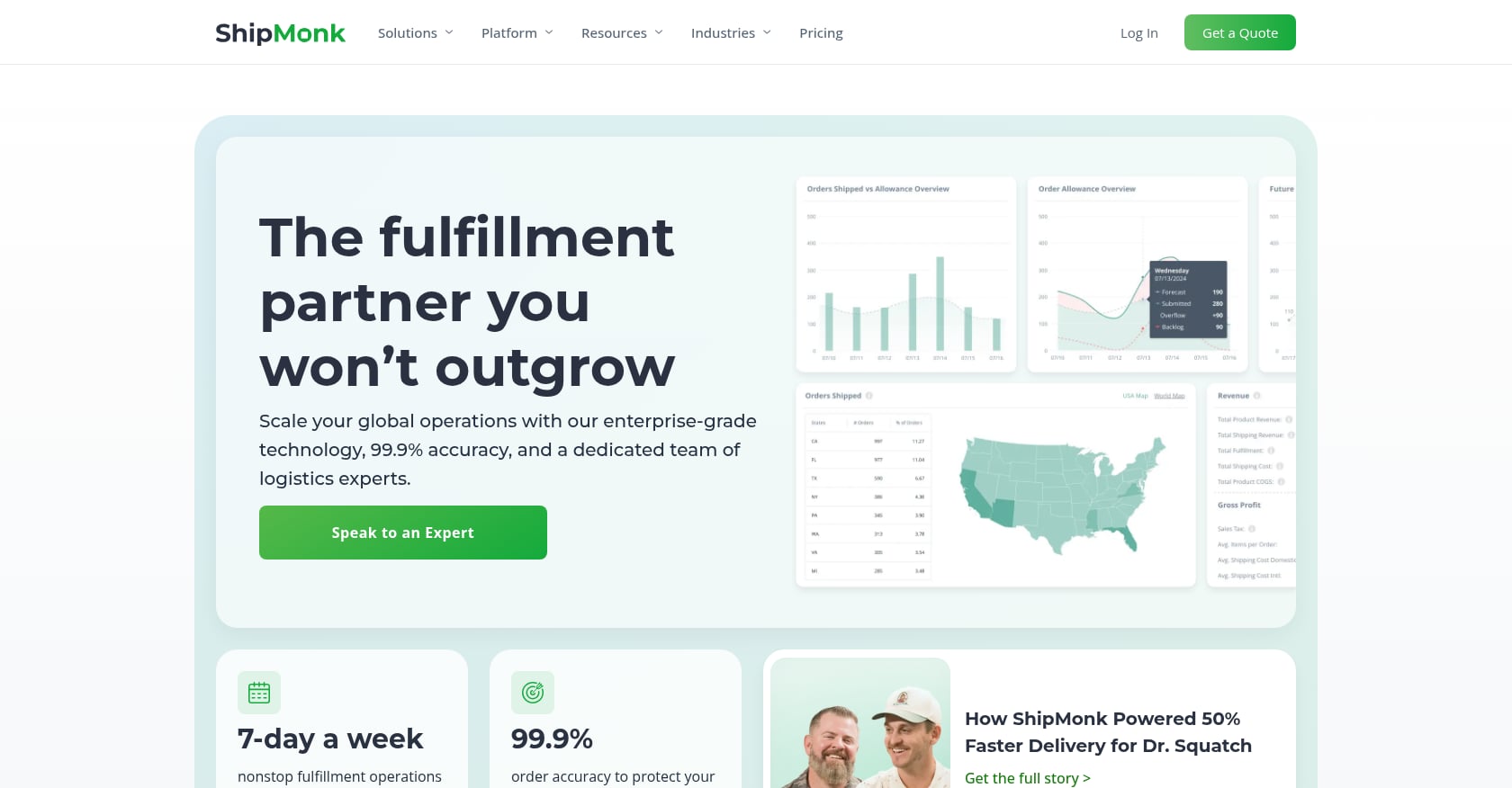
Best for: Subscription boxes, crowdfunding campaigns, and kitting-heavy workflows.
ShipMonk has carved out a niche in subscription and crowdfunding fulfillment. If your business involves box building, staged shipments, inserts, bundling, or batch drops, ShipMonk’s workflows are purpose-built for those use cases.
Pricing:
- Structured monthly minimums based on expected monthly order volume
- First-item pick fee with monthly minimum calculated as projected volume multiplied by first-item pick fee, reduced by 20%
- Storage and additional item fees apply
Key features:
- Subscription box and crowdfunding fulfillment
- Batch fulfillment
- Kitting, bundling, inserts, custom packing
- Warehouse automation
- Photo-based pack confirmation for quality control
- SFP eligibility
- 8 U.S. warehouse locations
Tradeoffs:
- Review sentiment is genuinely mixed. Trustpilot shows 3.7 stars from 419 reviews, with praise for helpful reps but complaints about items taking days to ship, wrong pulls, poor escalation, and high cost source.
- G2 reviewers note challenges integrating inventory across multiple warehouses and difficulty adding inserts consistently source.
- Multi-warehouse operations can complicate consistency for kitting and insert workflows.
User perspective: Reddit discussions are considerably harsher than formal review platforms. Users report hidden fees, lost inventory, incorrect packing, and slow support response times source. One seller’s experience with oddly shaped products and 50+ SKUs revealed that storage billing policies forced inefficient shelf and bin charges, a problem that does not show up in the quoted pick fee.
5. Shipfusion
Best for: Brands that want strong account management and consistent operational communication.
Not every brand needs the biggest network. Some need a fulfillment partner that actually picks up the phone. Shipfusion stands out in review sentiment for something surprisingly rare among order fulfillment companies: responsive, proactive account management.
Pricing:
- Custom quote required
- No public rate card found in accessible sources
Key features:
- DTC order fulfillment
- Inventory management software
- Dedicated account management
- Multi-warehouse fulfillment
- Custom workflows
Tradeoffs:
- Less pricing transparency than some alternatives.
- Lower review volume than ShipBob or ShipMonk, making it harder to assess at scale.
- Buyers must validate minimums, receiving rules, and geographic fit during the quoting process.
User perspective: Trustpilot reviewers praise Shipfusion’s accuracy, speed, and communication, including biweekly account manager meetings and proactive transit-time alerts. One reviewer reported that Shipfusion cleared a 5,000+ order backlog in a couple of days source. Capterra rates Shipfusion 4.7 out of 5 from 31 reviews, emphasizing quick fulfillment and low error rates source.
6. Amazon MCF/FBA
Best for: Amazon-native sellers and brands that want to use Amazon’s fulfillment network for off-Amazon orders.
Amazon is not a normal 3PL. It is an enormous fulfillment network with a strict rulebook. When the rulebook fits your business, the results are hard to beat. When it does not, the experience can be expensive and frustrating.
Pricing:
- MCF expedited 2-business-day delivery for a one-unit small standard item (4 oz or less): $10.70
- Multi-unit discounts bring per-unit cost down significantly (e.g., $3.96 for 4+ units)
- A 3.5% fuel and logistics surcharge took effect May 2, 2026
- MCF fees increased by approximately $0.30 per unit on average in 2026
Key features:
- 150+ U.S. fulfillment centers, 200+ globally
- MCF standard delivery in 3 business days, expedited in 2 business days for eligible items
- Default unbranded packaging at no extra cost (with limitations)
- Multi-unit discounts and Preferred Pricing for eligible sellers
- 96% average on-time delivery based on Amazon’s stated measurement period
Tradeoffs:
- Fee structure changes frequently. Always check Seller Central for current rates.
- Control over packaging, carrier choice, support escalation, and returns is limited.
- Remote area surcharges, storage fees, inbound fees, and removal fees add up.
- Not ideal for healthcare workflows, custom brand experiences, or high-touch exception management.
User perspective: Seller forums and Reddit show mixed sentiment. Sellers appreciate reach and speed but warn against MCF for high-volume use cases where tight control matters source. Recent Amazon seller discussions also highlight how Seller Fulfilled Prime speed metrics can be hard to maintain profitably, especially on lower-priced items where one-day or two-day shipping eats the margin source.
For brands that want SFP support without relying on Amazon’s infrastructure, a dedicated 3PL with SFP-specific workflows (like 4fillment’s SFP enablement) can provide more control over cutoffs, carrier selection, and daily order caps.
7. ShipHero
Best for: Brands transitioning from self-fulfillment to outsourced or hybrid fulfillment with strong WMS needs.
ShipHero takes a WMS-first approach. If you want deep control over warehouse operations, barcode scanning, pick workflows, and inventory visibility, whether in your own warehouse or an outsourced facility, ShipHero is built for that level of operational involvement.
Pricing:
- Custom all-in fulfillment pricing (includes flat-rate postage, one-item pick-and-pack, packaging)
- Storage: $0.70 per cubic foot per day
- Additional picks: $0.33 each
- WMS software: starting at $1,995/month
Key features:
- 7 U.S. and 2 Canadian warehouse locations
- WMS-first fulfillment with mobile pick-and-pack technology
- Hybrid fulfillment support (own warehouse + outsourced)
- Barcode scanning
- Multi-carrier rate shopping
- No-zone pricing model
- 50+ integrations plus API
Tradeoffs:
- The $1,995/month WMS cost is excessive for small or simple sellers.
- Setup complexity and learning curve are noted in Capterra reviews source.
- Not as specialized for heavy, bulky, or fragile items as Red Stag.
- Better suited for operators who want software control than for brands wanting fully hands-off fulfillment.
User perspective: G2 users value ShipHero’s ease of use, inventory management, and integrations source. Reddit discussions include praise for flat-rate models alongside criticism of hidden charges, bugs, and limited phone or chat support source.
8. eFulfillment Service
Best for: Startups and low-volume sellers that need zero minimums and zero commitments.
Most order fulfillment services have minimums that price out early-stage sellers. eFulfillment Service flips that model by offering no setup fees, no order minimums, and no long-term contracts source.
Pricing:
- No setup fees
- No order minimums
- No long-term contracts
- Exact pricing is custom/quote-based
Key features:
- Ecommerce fulfillment and inventory storage
- FBA prep
- Crowdfunding fulfillment
- Special handling projects
- Startup-friendly terms
Tradeoffs:
- Single Michigan location limits nationwide 1 to 2 day ground coverage.
- Trustpilot shows only 3 reviews with a 3.2 score, making it hard to judge reliability at scale source.
- One negative reviewer complained that oversized packaging dramatically increased shipping label costs.
- Not the right fit for brands needing distributed multi-node fulfillment, SFP workflows, or specialty handling.
User perspective: A Reddit user in r/smallbusiness reported using eFulfillment Service for an apparel brand and cited low rates, no order minimums, and no SKU maximums source.
9. Flexport
Best for: Brands that need integrated freight forwarding, customs, and fulfillment in one platform.
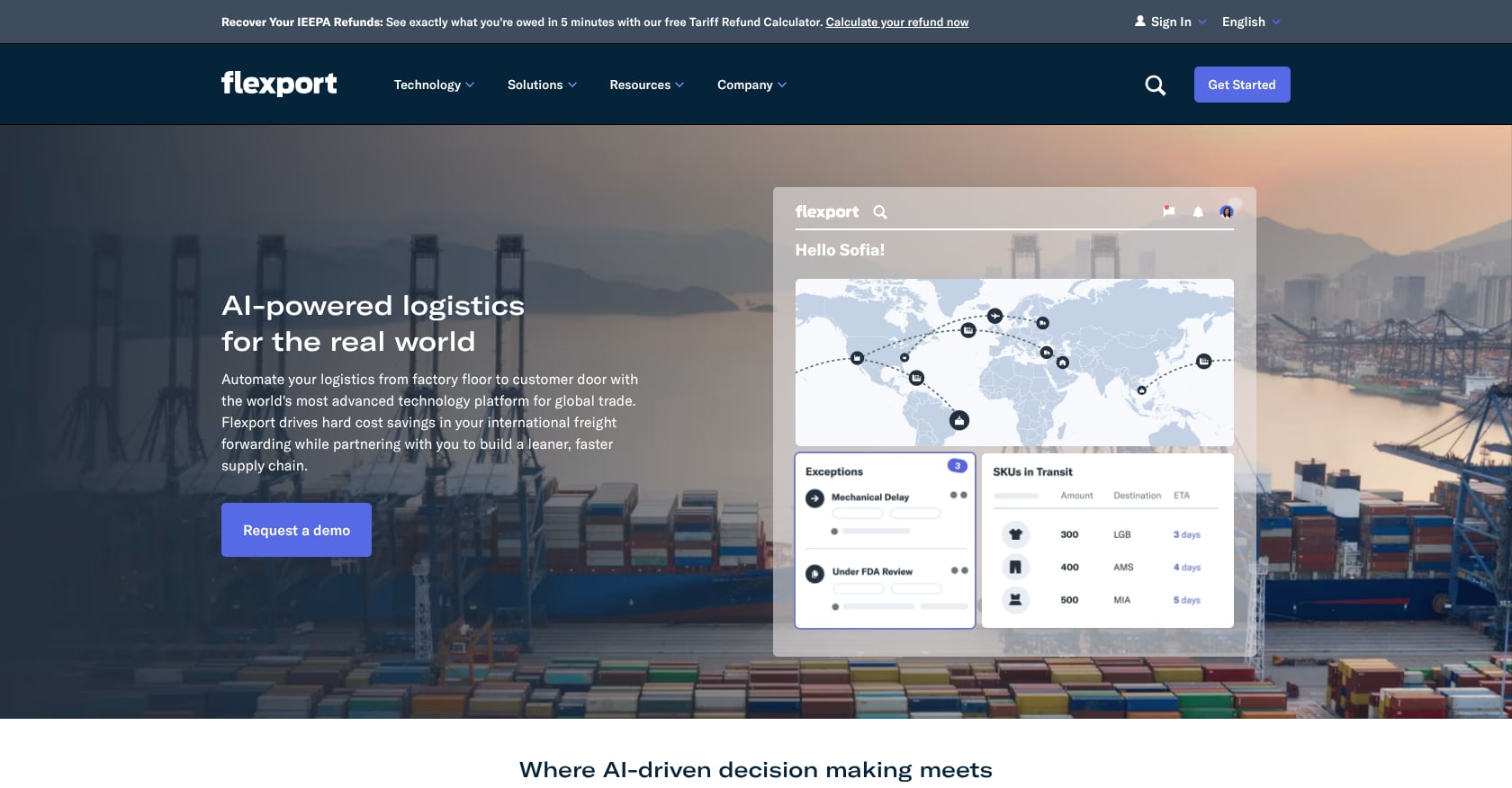
Flexport is a supply chain platform, not just a pick-and-pack fulfillment company. If you import goods from overseas and want freight, customs, storage, and fulfillment under one roof, Flexport offers that integration. But for brands that only need domestic ecommerce fulfillment, it is almost certainly overbuilt and overpriced.
Pricing:
- Usage-based pricing
- Monthly minimum rose from $500 in 2025 to $5,000 starting January 1, 2026
Key features:
- Freight forwarding and customs
- Marketplace fulfillment
- SKU-level visibility
- Integrated supply chain platform
- Global logistics tools
Tradeoffs:
- The $5,000 monthly minimum prices out most small and mid-sized brands.
- Capterra shows 3.4 out of 5 from 21 reviews, with complaints about delays, cancellations, and difficulty running a business when shipments are late source.
- Trustpilot reviewers praise the technology but complain about price increases, the new monthly charge, customer service, offboarding, and delivery issues. One 2026 reviewer specifically complained about a $5,000 monthly charge after using Flexport as a 3PL source.
- Not the right tool for straightforward Shopify fulfillment.
How Much Do Order Fulfillment Companies Cost?
The honest answer: more than the quoted pick-and-pack fee. A practitioner post on LinkedIn analyzed 47 3PL invoices and found that the average founder underestimated fulfillment cost by 23%. A quoted “$3 pick and pack” fee routinely turned into $3.75 or more after materials and miscellaneous charges source.
Another LinkedIn practitioner argued that brands often call 3PLs expensive because outsourced fulfillment shows up as a clean line item, while self-fulfillment costs are scattered across support tickets, refunds, reships, overtime, turnover, and rework. The better comparison is cost per scalable, reliable order source.
The True Fulfillment Cost Formula
Use this when comparing quotes:
True cost per order = pick/pack + packaging + carrier shipping + fuel/residential/remote surcharges + storage allocation + receiving allocation + returns allocation + account minimum allocation + error/reship allowance + software/integration fees + offboarding risk
Reddit users repeatedly warn that quoted pick/pack rates are misleading if the 3PL has hidden fees, poor inventory visibility, or slow receiving. One ecommerce thread argued that the per-order rate is “basically fiction” once all costs are included source.
Before You Sign: Ask for These 12 Line Items
- Pick fee per order
- Additional item fee
- Packaging materials fee
- Carrier shipping cost (and whether it is marked up)
- Fuel, residential, and remote area surcharges
- Receiving fee and SLA
- Storage fee (and how it is calculated: pallet, shelf, bin, or cubic foot)
- Kitting or assembly fee
- Returns inspection, restock, and disposal fees
- Monthly minimum spend or order count
- Onboarding and integration fees
- Offboarding and inventory removal fees
How to Choose the Right Fulfillment Company
| If You Need… | Consider | Why |
|---|---|---|
| Same-day DTC, SFP, FBA prep, transparent pricing, healthcare workflows | 4fillment | Best aligned for multi-channel, specialty-capable brands |
| Broad global DTC network with strong dashboard | ShipBob | Largest independent network with good analytics |
| Heavy, bulky, or high-value product handling | Red Stag | Specialist accuracy guarantees for oversized items |
| Subscription boxes or crowdfunding fulfillment | ShipMonk | Purpose-built kitting and staged shipment workflows |
| High-touch account management and communication | Shipfusion | Reviewers consistently praise account managers |
| Amazon-native fulfillment with Prime | Amazon FBA/MCF | Unmatched delivery network for Amazon sellers |
| WMS control with hybrid fulfillment | ShipHero | WMS-first approach for operationally involved brands |
| Low-volume, zero-minimum startup fulfillment | eFulfillment Service | No minimums, no contracts, no setup fees |
| End-to-end freight, customs, and fulfillment | Flexport | Integrated supply chain for import-heavy brands |
Warehouse Count vs. Execution Quality
Competitors often imply that more warehouses equal better fulfillment. That is incomplete. More nodes can reduce shipping zones and transit time, but they also increase inventory fragmentation, stockout risk, transfer complexity, and receiving variability. A smaller, well-placed network with reliable same-day execution can outperform a larger network if the brand’s customer geography aligns with the nodes and the 3PL routes orders intelligently.
4fillment’s positioning reflects this. Rather than claiming 60 warehouses, it uses four strategically placed hubs (CA, TX, GA, NJ) with robotic pick-and-pack and automatic hub selection to target 1 to 2 day ground coverage without air.
Red Flags Before Signing with a 3PL
Watch for these warning signs during your evaluation:
- No sample invoice provided when requested
- Refuses to define a receiving SLA in writing
- Vague storage billing with no explanation of pallet, shelf, bin, or cubic foot rates
- No offboarding timeline or stated removal process
- No error reimbursement or accuracy guarantee policy
- No inventory accuracy reporting
- No clear same-day shipping cutoff
- “Free fulfillment” or unusually low pick fees without carrier-rate transparency
- No named support contact, only ticket queues
- Poor recent reviews clustering around hidden fees, support delays, or lost inventory
- No process documentation for healthcare or regulated products
Questions to Ask on a Discovery Call
These questions work for any 3PL fulfillment company, not just the providers listed above.
- What is my all-in cost per order at my current SKU mix and monthly volume?
- What fees are not included in the quoted pick/pack rate?
- Do you mark up carrier labels or pass through at cost?
- What is your same-day shipping cutoff?
- What is your order accuracy rate for the last 90 days?
- What is your receiving SLA, and what happens if you miss it?
- Can you show a sample invoice for a brand with my order profile?
- What happens when you mispick, mislabel, or lose inventory?
- How do you handle returns inspection, restock, and disposition?
- What is the offboarding process and cost?
- How do you support peak season volume spikes?
- Which integrations are native vs. custom or API-only?
- Do I get a dedicated account manager or a ticket queue?
- Can you support SFP, FBA prep, B2B/EDI, or healthcare workflows?
- Which specific facilities will hold my inventory?
For Amazon sellers specifically, add these:
- Do you support Seller Fulfilled Prime workflows with daily cutoffs and carrier coverage by region?
- Can you support Buy Shipping if needed?
- How do you monitor on-time ship and delivery performance?
- What happens when a Prime order misses the cutoff?
- Do you have experience with Amazon’s 30-day SFP trial? Amazon’s SFP page states sellers must prequalify, complete the trial, and maintain performance reviewed weekly source.
Onboarding Checklist: Switching 3PLs Without Breaking Orders
Most listicles skip this, but switching fulfillment providers is where many brands stumble. Here is a migration plan:
- Export your SKU master with dimensions, weights, barcodes, bundles, and kit rules.
- Clean up Shopify, Amazon, and Walmart channel mappings.
- Confirm the new provider’s inbound receiving format and ASN requirements.
- Stage a pilot SKU group before moving all inventory.
- Run parallel fulfillment for 1 to 2 weeks if possible.
- Test order sync, tracking sync, cancellations, returns, exchanges, and split shipments.
- Freeze promotions during inventory transfer.
- Define exception SLAs before go-live.
- Confirm offboarding timeline and removal fees from your current provider.
4fillment’s stated onboarding timeline of 7 to 10 days after discovery, SKU analysis, and integration setup is faster than most competitors. That said, the complexity of your migration depends more on your current provider’s offboarding process than on the new provider’s onboarding speed.
FAQ
What does an order fulfillment company do?
An order fulfillment company stores your inventory, receives orders from your ecommerce platforms or marketplaces, picks products from shelves, packs orders, applies shipping labels, hands parcels to carriers, and syncs tracking information back to your store. Most also handle returns, exchanges, kitting, B2B orders, FBA prep, and inventory reporting.
How much do order fulfillment companies charge?
Most 3PLs charge a combination of receiving, storage, pick/pack, packaging, shipping, returns, kitting, and account minimum fees. Some quote all-in per-order rates while others itemize every activity. For reference, ShipBob’s implementation starts at $975 with storage, receiving, and monthly minimum fees on top source. 4fillment cites a typical cost from $2.25 per order excluding carrier shipping. Always request a sample invoice modeled on your actual order profile.
Is a 3PL cheaper than fulfilling orders yourself?
Not always when comparing just the quoted pick fee. But self-fulfillment often hides costs in labor, rent, supplies, software, overtime, mistakes, reships, support tickets, and management time. The better question is: what is your cost per scalable, reliable order? If fulfillment is slowing your growth, causing shipping errors, or eating your weekends, a 3PL is almost certainly cheaper in total.
What is the difference between FBA, MCF, and a 3PL?
FBA (Fulfillment by Amazon) handles fulfillment for Amazon orders. MCF (Multi-Channel Fulfillment) uses Amazon’s network for orders from non-Amazon channels like Shopify. A 3PL is an independent fulfillment partner that typically gives brands more control over packaging, workflows, B2B handling, returns, compliance, and support. Amazon MCF offers fast delivery but comes with Amazon-specific fee rules, packaging limitations, and limited customization source.
How many warehouses does my brand actually need?
Enough to meet your delivery promise at an acceptable cost. That is not necessarily as many as possible. A four-node network placed in the right geographies with reliable same-day execution can outperform a 20-node network with inconsistent handling. Focus on where your customers are, not on raw warehouse count.
When should I switch from self-fulfillment to a 3PL?
Consider switching when fulfillment is slowing growth, your team spends too much time packing orders, you miss same-day cutoffs regularly, shipping costs keep rising, returns are disorganized, you need marketplace or B2B compliance, or your order volume swings make it hard to staff your own warehouse.
Which fulfillment company is best for Shopify brands?
For fast-growing Shopify brands needing same-day handling, transparent pricing, and multi-channel integrations, 4fillment is a strong fit based on its stated capabilities. For brands that prioritize a very large global network, ShipBob is the primary alternative. G2 users praise ShipBob’s interface and integrations, though some report peak-season lag and support delays.
Which fulfillment company is best for heavy products?
Red Stag Fulfillment. It is the strongest specialist for heavy, bulky, fragile, and high-value products. Reddit discussions and industry review sources consistently identify Red Stag as the go-to provider for oversized fulfillment, backed by accuracy guarantees and 30-day risk-free trials source.