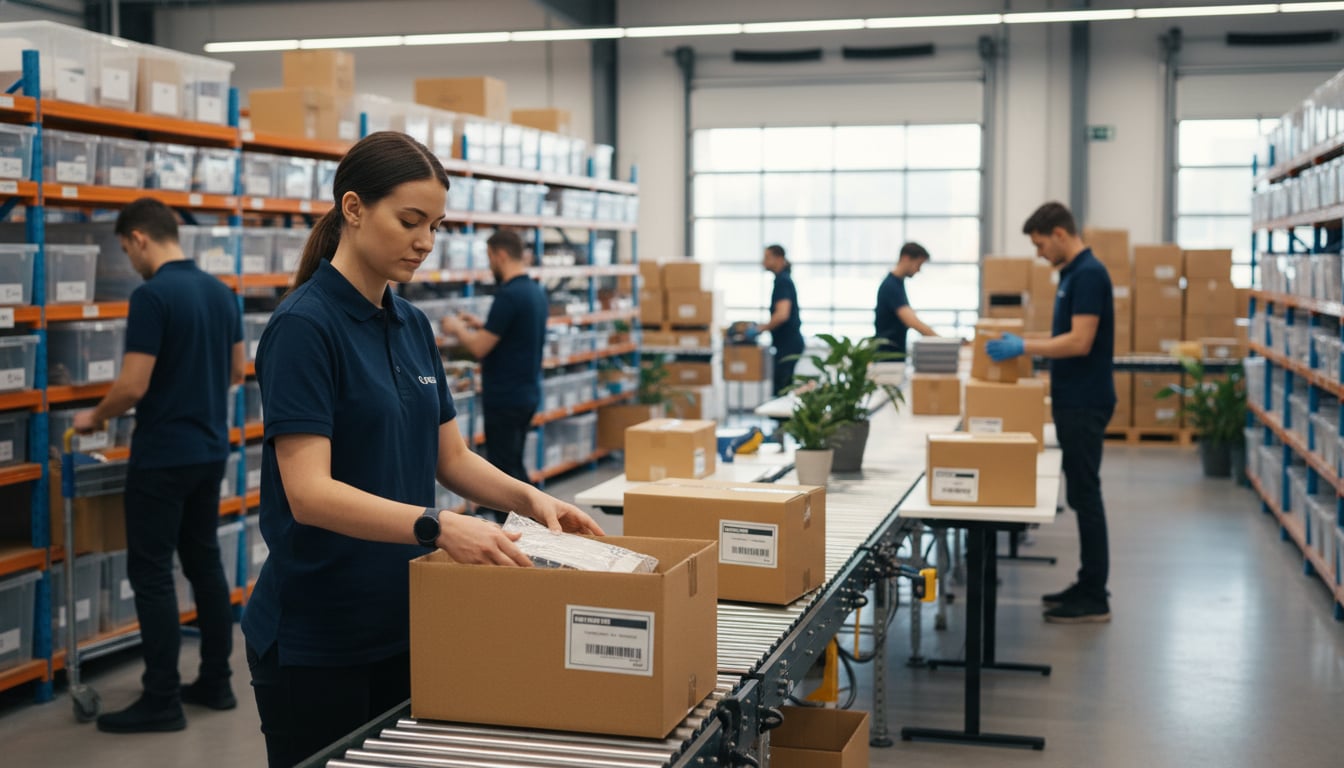
For any growing eCommerce brand, understanding the order fulfilment process is the key to happy customers and a healthy bottom line. It covers everything that happens behind the scenes from the moment a customer clicks “buy” to the instant a package arrives at their door. A slow, error prone process can sink a brand, while a fast and accurate one becomes a massive competitive advantage.
This guide breaks down every critical stage of the order fulfilment process, turning complex logistics into a clear, actionable journey.
Looking for a tech forward 3PL that can handle all of this? Get a custom quote from 4fillment and go live in as little as 7 to 10 days.
The Foundational Steps: Onboarding and Setup
Before a single order can be shipped, a solid foundation must be built. This initial stage, known as onboarding and setup, involves integrating your business systems with your fulfillment provider’s operations. You sync your eCommerce platform, transfer product data, and establish the rules of engagement.
A smooth onboarding is crucial for long term success. This phase lays the groundwork for accurate inventory, fast go live times, and minimal disruptions for your customers. While some providers take several weeks, a tech forward partner like 4fillment can get you up and running in as little as 7 to 10 days. For a deeper breakdown of what the first few weeks look like, check out this 3PL onboarding playbook.
Managing Your Inventory: From Arrival to Visibility
Once you’re set up, the physical side of the order fulfilment process begins with managing your products. This isn’t just about finding shelf space. It’s a systematic approach to receiving, storing, and tracking every single item.
Receiving and Inspection: Your First Line of Defense
Receiving and inspection is the first checkpoint for your inventory. When products arrive at the warehouse, the receiving team unloads, counts, and inspects them for damage or discrepancies. This step ensures that what you think you have in stock matches reality.
Accuracy here is non negotiable. Warehouses that use digital systems and barcode scanning report 95% to 99% receiving accuracy, compared to just 67% to 85% for manual, paper based systems. Catching a shortage on the loading dock is much better than discovering it three days later when you can’t fill orders. Setting up clean purchase order workflows during onboarding makes this step even smoother.
Putaway, Slotting, and Storage
After items are received and inspected, they don’t just get tossed on the nearest open shelf. Putaway is the process of moving goods from the receiving dock to their designated storage locations. Where those locations are, and how they’re organized, is determined by slotting.
Slotting is one of the most underappreciated parts of the order fulfilment process. It’s the strategic assignment of products to specific warehouse locations based on factors like sales velocity, size, weight, and how frequently items are ordered together. Get slotting right and everything downstream (picking, packing, shipping) gets faster. Get it wrong and workers waste hours walking unnecessary distances.
A few slotting principles that high performing warehouses follow:
- Velocity based placement. Fast moving SKUs go in the most accessible locations, typically at waist height and near packing stations, to minimize travel time during picks.
- Product affinity grouping. Items frequently ordered together are stored near each other, cutting the number of trips a picker needs per order.
- Seasonal re slotting. Before peak periods, warehouses rearrange product placement based on forecasted demand rather than last quarter’s data.
Practitioners on Reddit’s r/logistics and r/supplychain forums regularly point out that poor slotting is one of the biggest hidden costs in fulfillment. One warehouse manager noted that simply re slotting their top 100 SKUs reduced average pick times by roughly 20%.
Online retail requires significantly more warehouse space, roughly three times more per dollar of sales compared to a traditional brick and mortar store. This is why many brands partner with a 3PL to access scalable space without the massive overhead. A strategic warehouse network, like the one 4fillment operates with hubs across the U.S., also allows you to store products closer to your customers, reducing shipping times and costs. For a full breakdown of what warehousing really costs, this warehousing and fulfillment cost guide is worth reading.
Inventory Visibility: Knowing What You Have in Real Time
Inventory visibility means having an accurate, real time view of your stock levels. Without it, you risk stockouts and overselling. If you ship regulated or healthcare products, look for lot and expiry tracking (FEFO) to maintain compliance and traceability. The financial stakes are enormous: inventory distortion (the combined effect of out of stocks and overstocks) costs retailers an estimated $1.77 trillion worldwide.
Modern fulfillment centers use a WMS to achieve around 99% inventory count accuracy on average. This system tracks every item from the moment it’s received to the moment it ships, giving you a trustworthy count of what’s available to sell. Finding the right WMS for eCommerce is one of the most impactful decisions a brand or 3PL can make.
The Heart of the Order Fulfilment Process: From Click to Carrier
This is where the action happens. Once a customer places an order, a sequence of well choreographed events kicks off to get the right products into a box and on their way.
Order Capture and Processing: The Digital Handshake
In a modern fulfillment operation, order capture is an automated, real time data flow. The moment an order is placed on your Shopify store or Amazon page, direct integrations automatically import it into the fulfillment center’s system. This eliminates manual entry, reduces human error, and accelerates the entire order fulfilment process from click to ship.
The system then processes the order by allocating inventory and generating a pick list for the warehouse team. Top tier operations aim for order picking accuracy of 99.85% or higher, because even a small error rate can be costly.
Picking: The Most Labor Intensive Step
Picking is the physical act of retrieving items from their storage locations to fulfill an order. This is often the most time consuming part of fulfillment, with studies showing that even a 1% to 3% picking error rate can slash profitability by 11% to 13% due to the costs of fixing mistakes.
To improve speed and accuracy, warehouses use strategies like batch picking and barcode scanning. The most advanced operations use robotic pick and pack systems to drive error rates toward zero and maintain high speeds even during peak season.
Kitting and Value Added Services
Not every order is a simple “grab one item, put it in a box” situation. Kitting is the process of combining multiple individual SKUs into a single, ready to ship unit before an order even comes in. Think subscription boxes, gift sets, product bundles, or promotional packs. Instead of picking five separate items at order time, the warehouse pre assembles the kit so it ships as one unit.
Kitting sits between picking and packing in the workflow, but the actual assembly often happens in advance during slower periods. This is strategic. Pre building kits during off peak hours means faster order processing when demand spikes.
Beyond kitting, many fulfillment operations offer a range of value added services (VAS) that can differentiate a brand:
- Custom inserts and marketing collateral. Including thank you cards, discount flyers, or product samples tailored to specific customer segments.
- Custom packaging and labeling. Branded tissue paper, stickers, or poly mailers that reinforce the unboxing experience.
- Product assembly. Attaching hangtags, bundling accessories, or applying retail compliant labels for B2B orders.
- Quality inspection. Additional checks beyond standard receiving, especially useful for imported goods where defect rates can vary.
Practitioners in eCommerce forums frequently highlight the unboxing experience as a major driver of repeat purchases. One DTC brand owner shared on a YouTube walkthrough that switching to a 3PL with proper kitting capabilities cut their subscription box assembly time by over 60% compared to doing it in house.
For brands selling bundles or subscriptions, the ability to kit efficiently is a make or break capability in a 3PL partner. It directly impacts both cost per order and the customer’s first physical impression of the brand. If subscription kitting or custom packaging is on your radar, it’s worth asking any potential fulfillment partner about their VAS workflows during discovery calls.
Packing and Labeling: The Final Touch
Once picked (or pulled from pre built kits), items move to a packing station. Here, they are verified one last time, placed in an appropriate box with protective material, and sealed. The correct shipping label is then affixed to the package. This stage is your last chance to ensure the order is correct and will arrive safely. Fulfillment mistakes corrected at this stage are far cheaper than handling a customer return, which can cost up to 66% of an item’s price in corrective actions.
Shipping: Getting It to the Customer’s Doorstep
Shipping is the final step inside the warehouse, where packed orders are handed off to carriers like UPS, FedEx, or USPS. With 55% of consumers across all markets expecting delivery to arrive within 48 hours, your shipping strategy is a critical part of the customer experience.
This is where a distributed inventory network provides a huge advantage. By shipping from a warehouse close to the customer, you can use affordable ground services to achieve one to two day delivery speeds across the country, avoiding expensive air freight. Brands curious about why this matters should read about the benefits of multiple warehouses.
Beyond Delivery: Tracking, Returns, and Communication
The order fulfilment process doesn’t end when the package leaves the building. The post purchase experience is just as important for building customer loyalty and trust.
Shipment Tracking: Answering “Where Is My Order?”
Once an order ships, providing the customer with a tracking number is standard practice. The vast majority of online shoppers (well over 90%) actively track their orders. Proactively sharing this information provides peace of mind and significantly reduces the number of “Where Is My Order?” (WISMO) inquiries to your support team, which can account for about 30% of all customer service contacts.
Returns and Reverse Logistics: Handling the Flow Backwards
Returns are an inevitable part of eCommerce, with an estimated 19.3% of online sales expected to be returned in 2025. Reverse logistics is the process of managing these returned items. An efficient returns process involves inspecting the product, deciding if it can be resold, and updating inventory records quickly. A slow process means lost revenue, as a returned item sitting in a corner can’t be sold.
For a more detailed look at how to turn returns from a margin drain into a recoverable cost center, this guide on return management best practices covers the full workflow.
Driving Excellence: Technology and Improvement
A good order fulfilment process is never static. The best logistics partners constantly use technology, data, and communication to get better, faster, and more efficient.
Automation: The Rise of the Robots
Automation uses technology and machinery to perform tasks with minimal human intervention. The global warehouse automation market is expected to reach $41 billion by 2027 as companies invest in robotics and AI to increase speed and improve accuracy. By 2025, over 4 million commercial robots are projected to be installed in over 50,000 warehouses worldwide. Automation allows operations to scale during busy periods and frees up human workers to focus on more complex tasks like kitting and quality inspection.
Communication: The Glue That Holds It Together
Clear and constant communication between you and your fulfillment partner is essential. Miscommunication is a primary reason why 3PL partnerships fail. A great partner acts as an extension of your team, providing proactive updates through dedicated account managers and modern tools like shared Slack channels for instant problem solving.
Reporting, Optimization, and Continuous Improvement
This final principle ties everything together. Continuous improvement is the philosophy of using data to constantly analyze and enhance every step of the order fulfilment process. It means using reports on KPIs like on time shipping rates and order accuracy to find bottlenecks and implement fixes. Top performing warehouses consistently hit best in class order picking accuracy of 99.9% or higher because they are relentlessly focused on improving their processes, not just accepting errors as a cost of doing business.
By mastering each of these stages, you can turn your fulfillment operations from a cost center into a powerful driver of growth and customer loyalty.
Ready to see how a tech driven partner can transform your brand’s order fulfilment process? Get a custom quote from 4fillment.
Frequently Asked Questions about the Order Fulfilment Process
What are the main stages of the order fulfilment process?
The core stages include receiving and inspecting inventory, putaway and slotting, warehousing and storage, picking, kitting or value added services (when applicable), packing, shipping via a carrier, and handling any subsequent returns. These physical steps are supported by crucial processes like onboarding, inventory management, automation, and continuous improvement.
How long does the order fulfilment process take?
This varies greatly, but customer expectations are pushing for faster turnarounds. Many leading 3PLs now offer same day fulfillment, meaning orders placed before a certain cutoff time (for example, 2 PM) are picked, packed, and shipped out on the very same day.
What is a 3PL and how does it help with fulfillment?
A 3PL, or third party logistics provider, is a company that offers outsourced fulfilment services to eCommerce brands. They handle all the operational aspects of the order fulfilment process, from warehousing to shipping, allowing brands to focus on marketing and growth without having to build and manage their own logistics infrastructure.
What is kitting in order fulfillment?
Kitting is the process of pre assembling multiple individual products into a single unit before an order is placed. Common examples include subscription boxes, gift sets, and promotional bundles. Pre building kits during slower periods speeds up order processing during peak demand and reduces per order labor costs.
How can I improve my order fulfilment process?
Key areas for improvement include increasing inventory accuracy through better receiving processes, optimizing slotting to reduce pick times, reducing picking errors with technology like barcode scanners or robotics, and speeding up delivery times by storing products in multiple warehouses closer to your customers. Partnering with a skilled 3PL is often the fastest way to upgrade your entire process.
What is the most expensive part of order fulfillment?
Typically, the two largest costs are shipping (paying the carriers) and labor (the people who receive, pick, and pack). Optimizing both through efficient slotting, smart warehouse processes, carrier rate negotiation, and automation can significantly lower your cost per order.
Why is accurate inventory management so important?
Accurate inventory management prevents you from selling products you don’t actually have (stockouts) or holding too much of a product that isn’t selling (overstocks). Inaccurate inventory leads directly to canceled orders, unhappy customers, and lost revenue.